
Original materials by Nadiia Rekhtina
Dear colleagues,
Thank you for your interest in my workshop “When the Body Freezes While Life Keeps Flowing” at the conference of the European Association for Gestalt Therapy (EAGT) in Dubrovnik, October 2026.
When danger continues, freezing, reduced sensitivity and the holding back of movement can become ways of adapting to what is happening.
In the workshop we explored freezing as a natural protective response, and the possibilities of therapeutic support that helps to restore sensitivity, movement and contact with oneself gradually.
On this page you will find the presentation of the workshop and an extended article covering the theoretical foundations and the possibilities of therapeutic work.
I would be glad to hear your questions and feedback and to continue in professional dialogue. It matters to me when our shared reflections go on living in therapeutic practice.
Warmly,
Nadiia Rekhtina
Gestalt therapist, senior trainer and supervisor at the Kyiv Institute of Gestalt and Psychodrama (KIGiP), certified Gestalt therapist and supervisor of EAGT, dance movement therapist, Bodymind Gestalt therapy practitioner, member of IAAGT. Leader of the specialization “Bodymind Gestalt.”

Contact me:
Social media:
Email:
Presentation

Video
Article
When the Body Freezes While Life Keeps Flowing
Freezing as a way of adapting, and the specifics of Gestalt therapy work in a field of prolonged threat
Nadiia Rekhtina
Gestalt therapist and EAGT accredited supervisor, senior trainer at the Kyiv Institute of Gestalt and Psychodrama (KIGiP), leader of the specialization “Bodymind Gestalt”
This material is based on an open lecture at the Kyiv Institute of Gestalt and Psychodrama
Contents
- When the danger doesn’t end
- One word, different bodily processes
- Freezing as a creative adjustment
- When a person copes but remains in danger
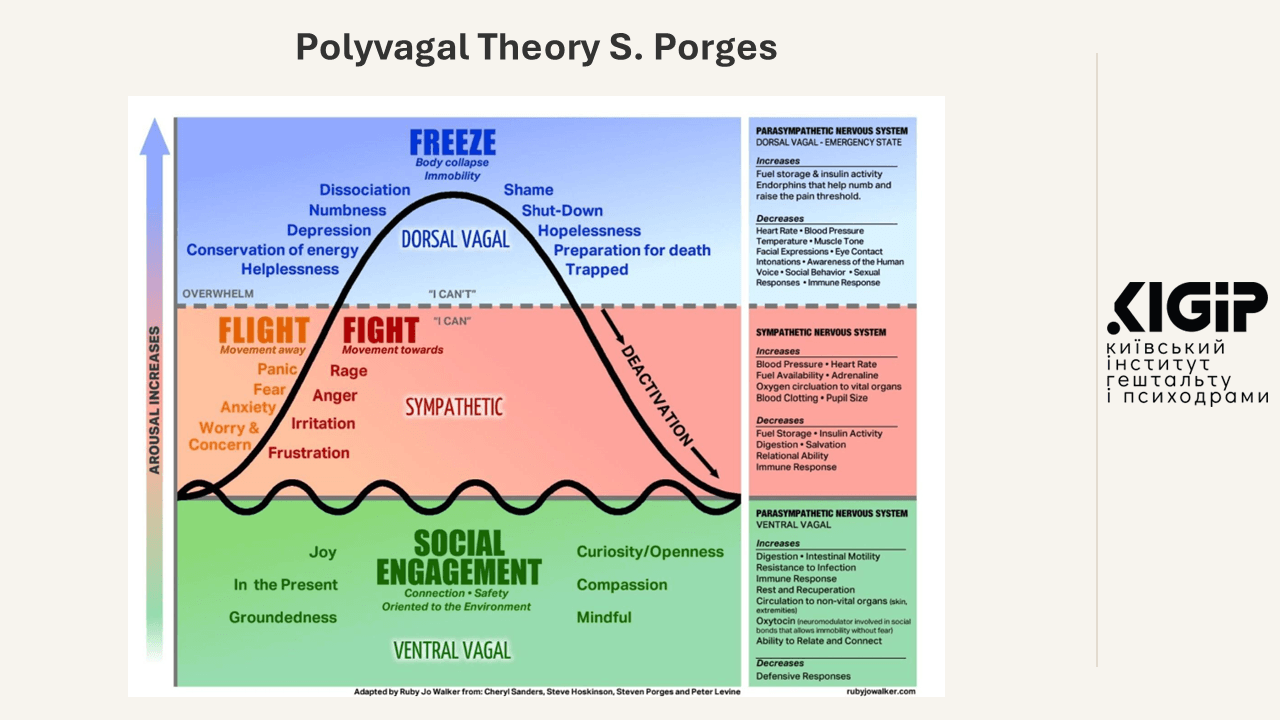
- Polyvagal theory: understanding the different states of the nervous system
- Retroflection and desensitization: why it matters to tell them apart
- Supports
- Therapeutic traps: when we ourselves lose contact
- From working through a past threat to supporting life amid a present one
- The heart under the ice
- References
When the danger doesn’t end
When we talk about freezing, it is important for me to state my position from the very beginning. I have long paid close attention to this subject, but my position remains that of a researcher. I don’t want to speak as someone who already has all the answers. Rather, I want to make sense of the subtle processes we encounter in therapy. The word “freezing” itself, in my view, describes many different processes. I am interested in telling them apart—or, more precisely, in choosing a therapeutic perspective and approach, and understanding how to meet a person who comes to a therapist in this state. This topic becomes especially relevant in the fifth year of the full-scale war, when we live in a field of constant threat.
When I was first studying and learning to work with trauma, the focus was mostly on what had already happened and on how to work with it. But what do we do when tension and danger continue? Everything we might call freezing is a way of adapting. How do we work with it if this way of adapting helps in some respects but also gets in the way? Sometimes clients describe their experience in these words: “I understand everything, I know everything, I know how it should be and what it’s connected to, but I react differently.” Cognitively, a person may understand what is happening and yet remain bodily stuck, as it were.
It seems to me that therapists and clients have, to a certain extent, fallen into a trap of grounding techniques. In the first months and the first year of the war, Ukrainian therapists tried, it seems, every grounding method they knew. Even beginner therapists are now well versed in these techniques, and clients know a lot about them too. But what is the trap? When I know something cognitively and understand its meaning, I may stop doing it. The therapist asks, “Do you feel your feet on the floor?” And the client answers, “Again? Enough already.” And at the same time, the person may not give themselves support, may not make use of what they know so much about.
This is a kind of split between body and knowledge: I already know, so I can skip doing it. Grounding is not only feet on the floor. But it is an important first step toward being able to touch the freezing. What we do as therapists begins with the ability to notice ourselves. To pause and notice where I am right now, how I feel, whether I’m comfortable, whether there is tension, whether I feel support. There is no need to change anything. Sometimes it is enough, at first, simply to notice what is there. You can pay attention to the position of your body, feel where it is comfortable and where it is not. If a wish arises to change position, you can do it in whatever way suits you right now.
In effect, this is the natural process of orienting: pause, notice, sense and, perhaps, change something. We welcome this process. The difficulty arises when the pause becomes fixed and unchanging, when it is hard for a person to come out of it. It is especially important that the therapist also notices themselves during the session: Have I gotten stuck? Have I frozen myself? Am I staying in contact with my own bodily experience?
One word, different bodily processes
To tell apart what we call freezing, I want to turn to four illustrative monologues. These are not literal quotes from clients but descriptions of states we may encounter.
The first state:
“There is tension inside, a storm inside, but I’m not moving. I catch myself sitting there telling myself: ‘Stop, hold still.’ Even my breathing is more careful, restrained. It feels like if I do anything, it will get worse. Stop, don’t. And I freeze, while inside there’s a storm.”
The second state:
“It’s hard for me to relax. I’m constantly scanning what’s going on: listening, watching, thinking. I’m tense, but I hardly notice it. If you don’t ask me, I won’t notice at all what state I’m in. I’m all outward, as if constantly on alert, though I don’t even know what for. That’s why I have so many thoughts. I start scrolling social media and can’t stop.”
The third state:
“Everything’s fine with me, everything’s okay. I wake up, go to work, talk to people, deal with things, do everything that needs doing. Overall, I cope. But if I stop and ask myself what I want, I can’t answer, I don’t know. It’s empty. I function well, everything’s in order, but inside there seems to be no movement. I have a feeling that I’m looking at my life a little from the side. I’m not suffering, but inside I seem to have frozen.”
The fourth state:
“I just don’t care somehow, I don’t feel anything, and I have little strength. It’s as if something in me can no longer react the way it used to. Sometimes it seems I can’t experience anything at all. As if my heart isn’t with me at all. I don’t quite understand it, I’ve lost any sense of meaning and don’t know what it is.”
In each of these stories, a person might say: “I froze.” But the dynamics and energy of these states are different. For the therapist, it is important to listen not only to the words the client uses to describe their state but also to how their energy is organized. A client may use many metaphors, searching for language to describe emotional and bodily experience. But it matters for us to notice small phenomena and to distinguish what exactly is happening. Freezing is there, but the processes behind this word can be different.
Freezing as a creative adjustment
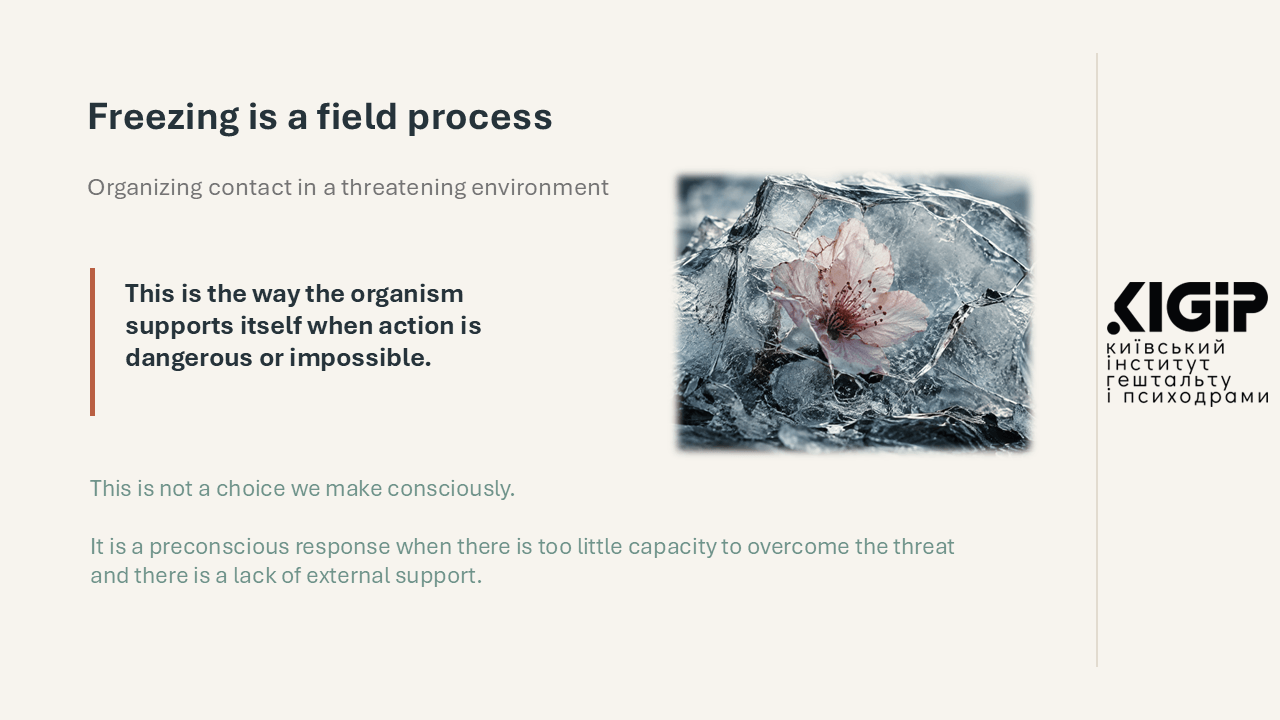
If we look at freezing from the standpoint of Gestalt therapy, first of all we see a field process. It isn’t simply “my problem” or another person’s problem. From the standpoint of field theory, my reactions, including freezing, are a response to the environment, a way of making contact with a field of threat in which movement and action have to be held back. Energy may remain mobilized. But action is dangerous or impossible. And then the only thing I can do is freeze. This is how the organism supports itself. I never exist separately from the environment. My reaction arises in contact with it, and I cannot fully influence it.
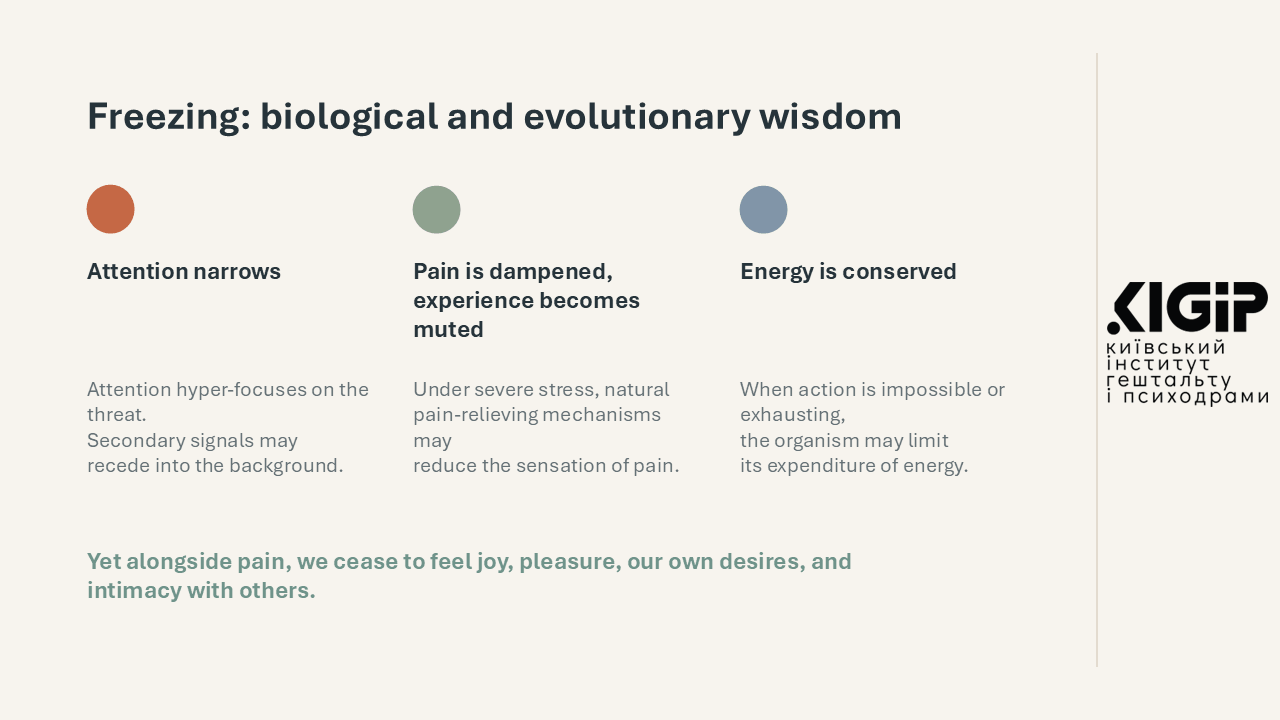
If we look at freezing as a field reaction, we can see a certain wisdom in it. This state is not weakness. Clients sometimes say: “I’m weak. I’m a grown, intelligent person, and I know it should be different.” But a deep evolutionary wisdom of the organism is at work here. It does everything so that the person stays alive in whatever contact with the environment is possible right now. While anticipating future danger, the nervous system seems to cut off excess stimuli. If a person stayed intensely sensitive to everything going on, it could turn out to be too much.
This limiting of stimuli helps protect against emotional overload and maintain the functioning of the prefrontal cortex. On the physiological level, I connect this, among other things, with endogenous opioids, which create a kind of natural anesthesia. The organism reduces the intensity of experience so that a person can endure, for example, horror, and still keep functioning, making decisions and doing what is necessary. A person may know what to do, act, and even make decisions, yet remain frozen inside.
Freezing and numbness are more economical than constant mobilization of resources. This also helps the organism survive, especially when resources are chronically scarce. As Gestalt therapists, we can see a creative adjustment here: limiting contact with a dangerous environment in order to adapt temporarily to conditions where there is not enough support, where something must be held back. This allows us, to a certain extent, to preserve selective attention and not be overwhelmed by experiences. And there is an important point here: we do not choose this state. A person cannot cognitively decide to freeze or to go numb. It is the response to a dangerous situation that the organism is capable of giving.
When a person copes but remains in danger
In everyday life a person may say: “Yes, there is stress, but I’m coping. I go to work, I do everything that needs doing.” At the behavioral level this really can be adaptation. But at the level of the nervous system, adaptation may be incomplete. It is important for me to turn to the biological aspect, because it supports me as a therapist when I see a person who seems to be coping but bodily remains in a different state. Research on prolonged stress, including its effect on child development, points out that constant stress does not necessarily train resilience. It can exhaust the mechanisms of adaptation and make the nervous system more sensitive.
A person may think they have become less sensitive to danger: for example, they have almost stopped reacting to explosions. But this does not mean the nervous system has become “armored.” It may become even more exposed. Science has the concept of allostatic load—the price the organism pays for constant mobilization. Many processes take place in the central nervous system in this case. The amygdala takes part in recognizing danger even before a person becomes aware of what is happening. That is why I can understand perfectly well cognitively that it is safe right now, yet experience the situation completely differently.
If the amygdala recognizes something as dangerous, tension and energy for defense rise. During constant threat it can become hypersensitive, and even neutral signals will be perceived as dangerous. The nervous system keeps searching for danger and makes it the figure. The hippocampus is connected with memory and the integration of experience. During prolonged stress it may be harder for a person to make sense of events and connect them. The prefrontal cortex takes part in regulating emotions and controlling impulses, so its effectiveness may decline under prolonged stress. Why do we therapists need to understand these processes? First of all, to remember: a person does not choose them.
We can’t simply tell a client, or ourselves, “Calm down.” Such advice appeals to cognitive capacities, whereas the danger-recognition system may already be maintaining a state of tension. Cognitive understanding is not enough in such a case.
Polyvagal theory: understanding the different states of the nervous system
Stephen Porges, the author of polyvagal theory, proposed a way of understanding the processes of the nervous system that turned out to resonate strongly with the Gestalt approach. He describes the nervous system under danger as a kind of sensitive radar, tuned to search for the slightest signals of threat. In Gestalt therapy we might say that danger becomes the figure.
Polyvagal theory, introduced by Porges in 1994, expanded the usual understanding of the reactions of the autonomic nervous system. Traditionally we spoke of the sympathetic and parasympathetic systems: one connected with mobilization, the other with calming. Polyvagal theory offers a more complex picture, distinguishing two complexes of parasympathetic regulation, the ventral and the dorsal, both provided by the vagus nerve (Nervus vagus). For simplicity, a traffic-light metaphor is used. Of course, the nervous system is not literally green, yellow or red. It is just a way of seeing different processes.
Green zone. Ventral vagus: the social engagement system.
Imagine a day off. We are sitting at lunch with our best friends. The food is delicious, we’re having fun, joking, chatting playfully. It’s as if the heart opens. We’ve eaten, the food is being digested. We feel good and calm. It is possible to be near others. In polyvagal theory this kind of state is linked to the ventral vagus: social engagement, closeness and trust. When people say “the heart opens,” it is not only a metaphor. The vagus nerve runs from the brainstem to the organs of the chest and abdomen, including the heart, lungs, stomach and intestines. So the experience of openness and calm also has a bodily dimension.
Yellow zone. Sympathetic mobilization.
If something happens and danger arises, energy rises. The heart beats faster, breathing quickens, muscles tense, digestion becomes difficult. The organism mobilizes to do something about the danger: to fight or to flee.
Red zone. Dorsal vagus: collapse and immobilization.
Within the polyvagal model, if mobilization produces no result or there is not enough energy to overcome the danger, a shift occurs to the dorsal state: collapse, reduced activity, immobilization. This is an automatic reaction. A person cannot consciously decide to activate the dorsal vagus. In nature we can observe collapse reactions in many animals. When an animal can no longer escape a predator, it may fall into a state of immobility. Sometimes this gives it a chance to survive.
In ordinary life energy naturally rises and falls. In the morning there may be more of it; in the evening we get tired and want to sleep. This is normal movement.
When danger arises, the wave of activation becomes higher. If the capacity to cope is insufficient, the red zone may set in. In the book The Body Keeps the Score, Bessel van der Kolk describes this process as follows:
“Whenever we feel threatened, we instinctively turn to the first level, social engagement. We call out for help, support, and comfort from the people around us. But if no one comes to our aid, or we’re in immediate danger, the organism reverts to a more primitive way to survive: fight or flight. We fight off our attacker, or we run to a safe place. However, if this fails—we can’t get away, we’re held down or trapped—the organism tries to preserve itself by shutting down and expending as little energy as possible. We are then in a state of freeze or collapse.”
One can picture this as a wave. At first I am calm, able to talk, to make contact. If something happens, orienting arises. If the threat isn’t confirmed, I return to calm. If there is danger, energy rises. If this energy isn’t enough, collapse may occur, reduced sensitivity, numbness. This is sometimes described with the metaphor of pressing the gas and the brakes at the same time. The person seems to get stuck. They may say they feel “wrapped in cotton wool,” that there are fewer sensations, that the body feels almost frozen.
Sometimes it is possible to come out of this state after a while, especially with support. But when the field of danger persists, the threat repeats once, twice, a third time, and the person may remain in this state for longer and longer. A system that constantly searches for danger sustains this state.
Retroflection and desensitization: why it matters to tell them apart
Here we come to a distinction that is important for Gestalt therapy practice. A client may call two different processes “freezing.” In the first case, energy is there, but action is stopped. In the second, access to energy, impulse and sensitivity is significantly reduced.
When there is an impulse, but it is stopped
The first process can be described like this:
“I need to do something, but maybe not right now. I feel energy, I feel strength and an impulse, but I’m not acting yet.”
The person holds themselves back. Energy directed outward stops and stays inside. In Gestalt theory we call this retroflection. The first two monologues I began with can be seen precisely as such retroflective states. There is mobilization, tension, impulse. The person has frozen, but is still present in their own bodily process. There is awareness. If we support the person in staying with themselves a little longer, a figure may emerge—of what is threatening, or of what they wanted to do but stopped. Gradually an orientation arises in the space of their own life: what choice was stopped, how exactly this happened, which action remained unrealized.
The key criterion is high bodily energy. This state can be very intense and difficult, but it contains the potential for movement. With a little more support, movement, breath and words may emerge, along with the possibility of unfolding the process.
When access to the impulse is lost
The other process is when inhibition has already occurred in the nervous system, one the person did not choose, and numbing has set in. In Gestalt therapy we speak of desensitization. Here there is no available strength, there is not enough sensitivity, the impulse is not noticed. In the cycle of experience, desensitization is located at the very beginning—where awareness of a need has not yet arisen. In retroflection a person may be aware of what they are doing or not doing. In desensitization, access to experience itself is significantly limited. This can show up to varying degrees: from a marked reduction in sensitivity to almost complete numbing and dissociation.
The energy of the need is, as it were, shut off at the very beginning of the cycle. If a person stays in such a state long enough, it becomes hard for them to feel their own needs. And if I don’t feel my needs, I can’t fully satisfy them. Gradually this can lead to a loss of pleasure, of the taste for life, and sometimes of the sense of meaning. Outwardly a person may keep functioning, going to work, doing what is necessary, but inside there seems to be no movement. Another person may experience almost complete exhaustion, apathy, listlessness. Sometimes a client says: “I’m relaxed.” But when asked whether this relaxation is pleasant, you may hear: “No, it’s hard.”
Another variant is when there is little energy but there is also irritation. A person may describe it in these words: “It’s as if I have no skin, everything irritates me.” This is not necessarily the force of anger or the energy of a fight. Rather it is an experience of needing to arrange things so that nothing touches me. A client may say:
“I don’t feel anything, as if I’m not there. I’m numb. I have almost no strength. I rest, I go to bed, I look after myself, but strength doesn’t come.”
It is hard for a figure to form here. In the cycle of experience, this is the pre-contact zone. The figure of the therapeutic work becomes this state itself. The key criterion is the loss of access to impulse, intention, experience.
Working with retroflection
When we meet freezing, the first step is awareness. It is important to acknowledge the state that is there.
With retroflection, we can then gradually explore what is mobilized and help the person see their own impulse. The focus of attention is on bodily tension. “Where do you feel this in your body? Where most?” We explore the impulse: “What wants to happen? Where is this energy rising toward?” In this way the person can gradually see, feel and become aware of the intention, the held-back movement. And it is also important to explore and acknowledge the force that stopped this impulse. “How did you stop yourself? How does this holding back happen?”
When we pay attention to the counteraction, the person can gradually become aware of it and look for a creative way of acting. We support the unfolding of a movement that already exists in the bodily process. At the same time, it is important for the therapist not to follow their own energy and not to intensify the process beyond what the client can handle.
We can work through micromovements. If a person has frozen, we can explore the direction of their impulse. What would happen if they made only a small step, say, five percent? What movement might then be born? The person can try to imagine it or perform it a little. Gradually they become aware of their intention and can find a creative way of acting that is possible right now.
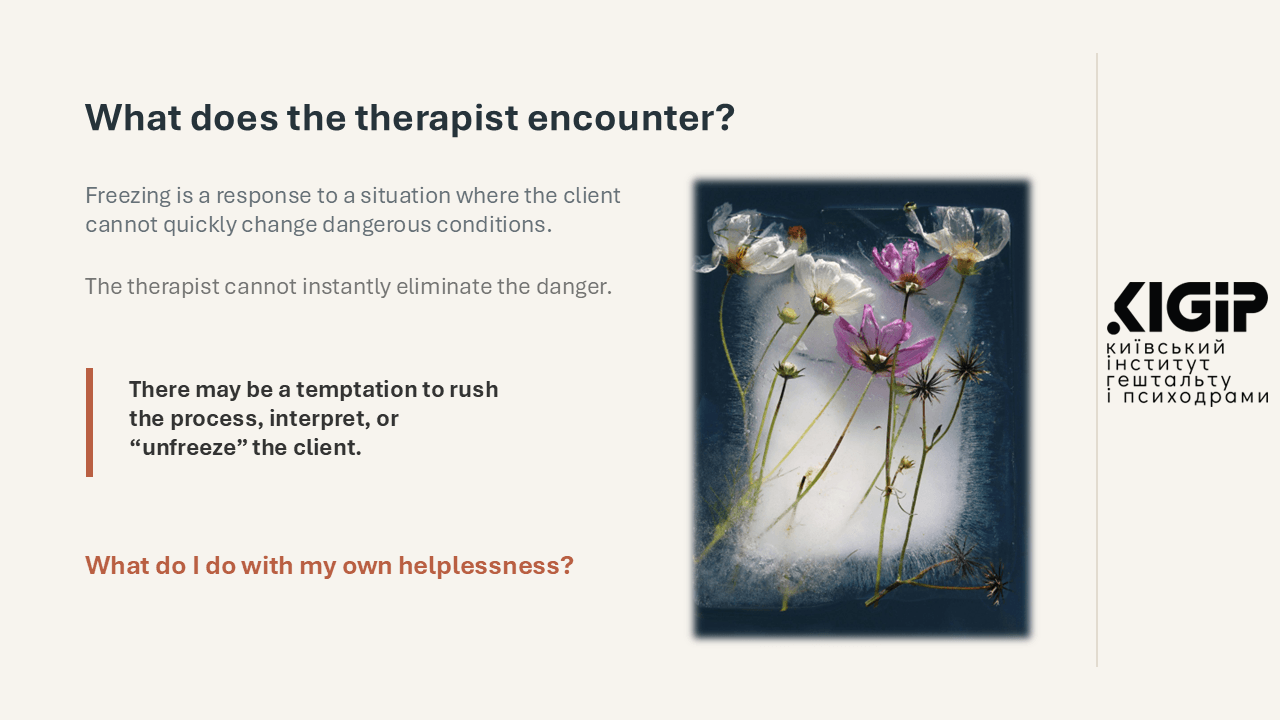
Important: our job is not to “thaw” the client. When a therapist sees someone who has gone rigid, they may feel a strong urge to thaw them. And with the best and warmest intentions. But if we start thawing the person, it may turn out to be too much. We help not with the “thawing” itself but with awareness of the process, the unfolding of the impulse and need, and the search for ways to satisfy it.
In a field of constant threat, conscious deflection can partly help as a way of creative adjustment. For example, if an impulse is very intense but cannot be directed straight at the source of the threat, physical activity outside therapy can give this energy some outlet. This will not be a direct satisfaction of the need. Yes, it is a deflective way. But it can support the system, help it come alive a little, return to the possibility of contact and of receiving support from the environment.
When there is no movement: working with desensitization
With desensitization we have a different therapeutic situation. If the impulse is unavailable, the focus of the work shifts. Now we are not talking about unfolding the impulse, even very slowly and attentively. Our task is to help the person restore basic sensitivity and contact with their own bodily experience. And here lies one of the serious therapeutic traps: trying to actively “melt” the freezing. Gestalt therapy has wonderful expressive experiments. They can work well in certain situations. But not here. Freezing is a protective, adaptive way of adjusting to an environment in which support is lost or insufficient.
Any pressure or insistence from the therapist, even with the best intentions, may be perceived by the client’s nervous system as an additional threat. A client may understand the therapist’s suggestion cognitively, trust them and even agree to an experiment. But at the same time their whole system may react to it as danger. It is important here to remember the metaphor of the gas and the brakes. Before the freezing, a very intense process may have been taking place. As if the gas and the brakes had been pressed at the same time. This is not simply an absence of energy but a state that was preceded by heavy strain. So an attempt to activate the person even more can strengthen the protective reaction.
An intense expressive experiment in such a state can lead to a panic attack or an even deeper freezing. We do not try to activate the client for the sake of activity. Our task is to be with them where they are and to help gradually bring back the ability to feel.
Supports
In this work I rely on several important aspects. I don’t want to call them sequential steps, because this is not a “one, two, three” algorithm. They are rather the therapist’s supports, which help to stay close to the client.
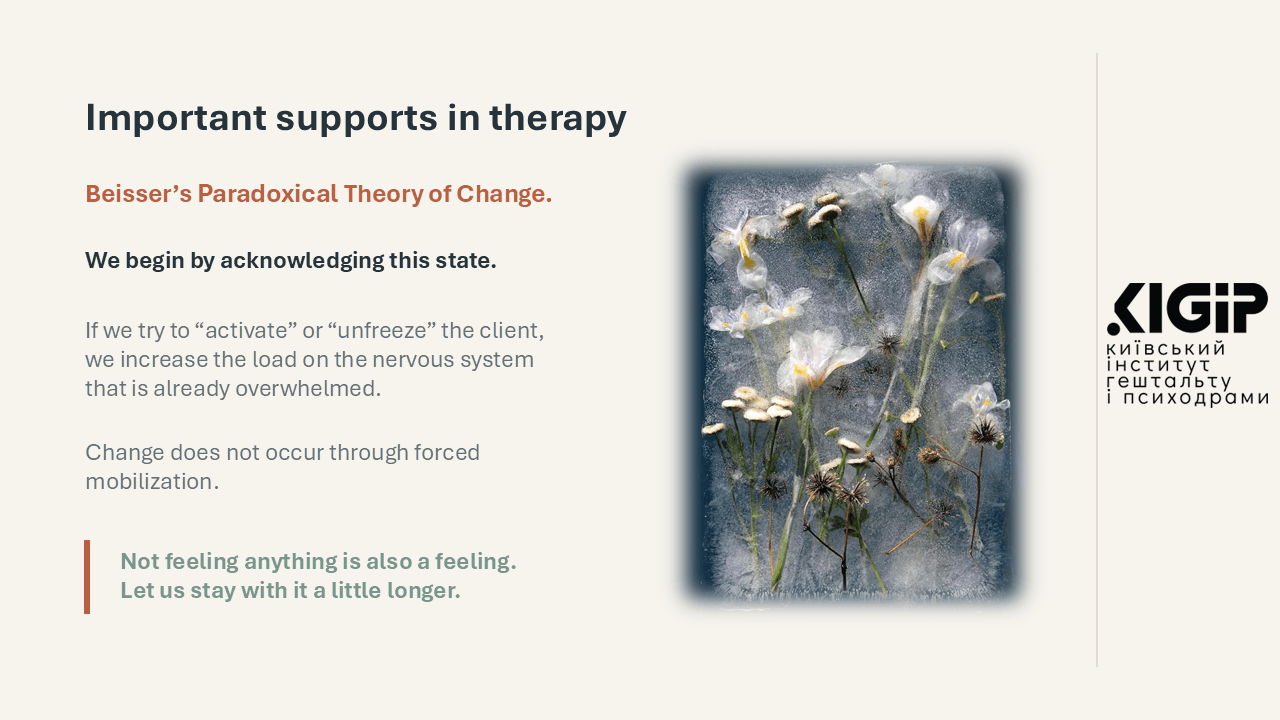
The paradoxical theory of change: starting by acknowledging what is
The first support for me is Arnold Beisser’s paradoxical theory of change. It reminds us that real change happens when a person accepts themselves as they are now, rather than trying to become someone else. In working with freezing this is especially important. We start by acknowledging what is given and the organismic wisdom of the state. A client may say: “I don’t want to be like this. I want it to be different.”
However, a cognitive decision alone is not enough here. To come out of a state of immobility, it is important for the client to feel their state bodily, organismically. Acknowledgment happens through awareness. When a client can say, “Yes, I froze,” that is already important.
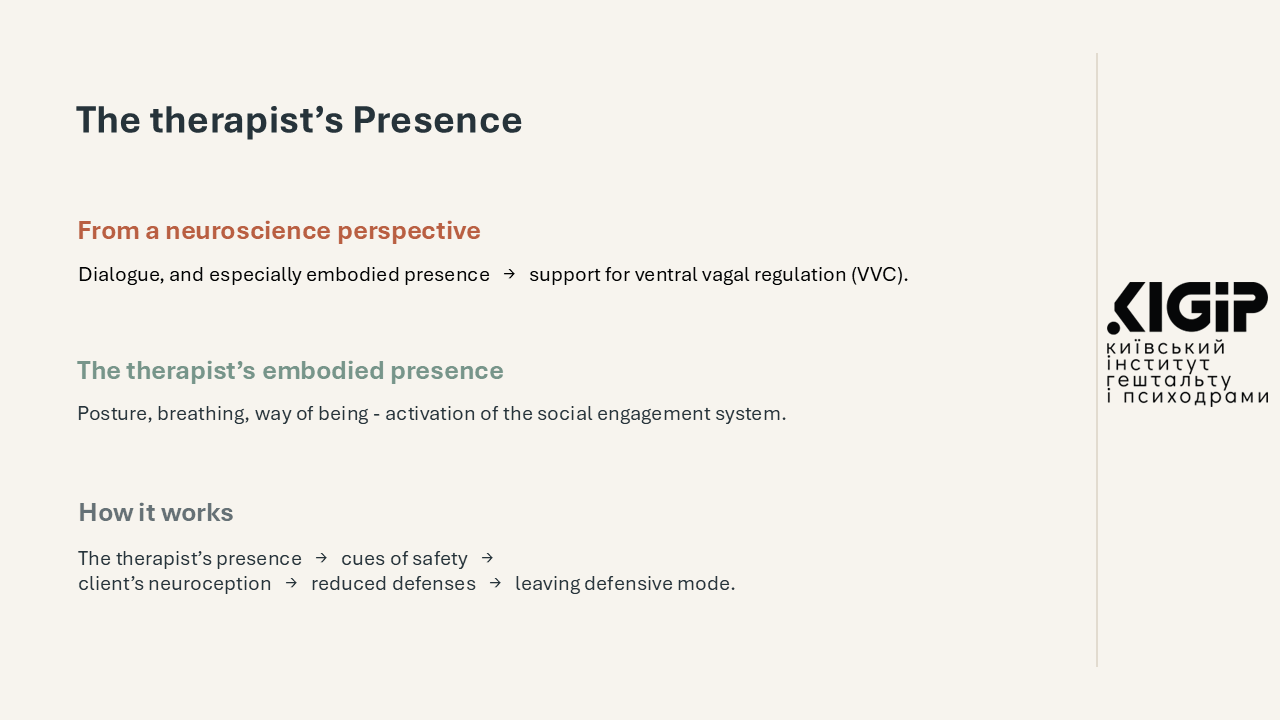
Dialogue and the therapist’s bodily presence
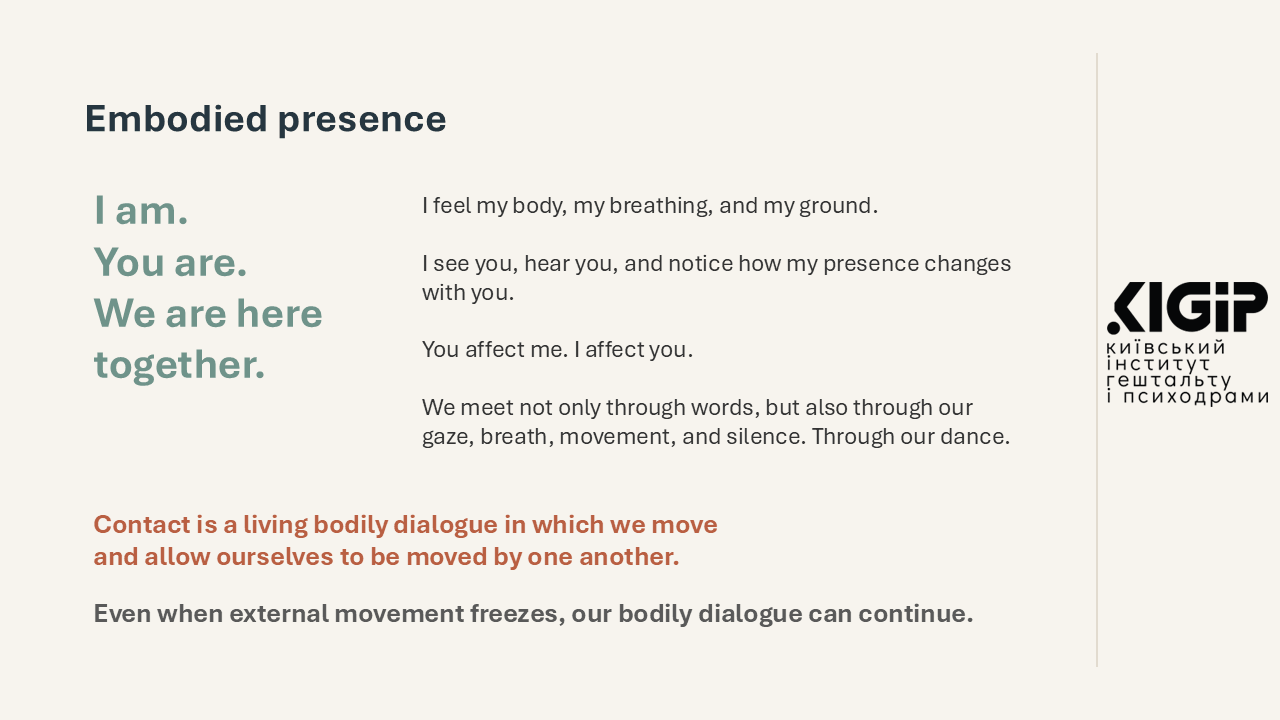
The second important support is Dialogue and the therapist’s bodily presence. What we in Gestalt therapy call Dialogue, a genuine meeting at the contact boundary, can partly be linked to the processes of social engagement that polyvagal theory describes through the ventral vagus. Recall that description: when we sit with people close to us. This very possibility of contact becomes one of our landmarks in therapy. But presence is not just sitting nearby and talking. “I meet you here. I am with you while staying in contact with myself.”
If the therapist loses contact with themselves, it is harder for the client to find themselves alongside.
We humans communicate not only with words and cognitions. As living beings we speak with our whole selves. In Gestalt therapy we can speak of kinesthetic resonance. Neurobiological explanations turn to mirror neurons and the interaction of the vagal complexes. For me the meaning remains this: it matters for us to be in what Martin Buber called Dialogue. In dialogue there is openness: not knowing in advance, being with a person as they are, staying present, allowing them to touch me.
The whole of our bodily and nervous system is present in dialogue. If I only know an algorithm—first do one thing, then another, then say a third—but am not bodily present myself, that is not enough. This is why in Gestalt therapy we give so much attention to embodied, bodily presence. For me it is one of the pillars of our work. The therapist’s bodily presence means being here, feeling oneself, having grounding in the broad sense.
If we translate grounding into human language, it is permission to be supported by oneself in one’s own feelings and sensations. It is not only feet on the floor. It is the ability to support oneself even in intense experiences. It is important for the therapist to notice what happens to them when they are with a client who is in freezing. What is happening with my breathing? Do I feel myself? Do I remain open? Do I have support? A soft gaze, openness, presence—all of this has not only a psychological but also a bodily dimension. When we speak of a slightly open heart, I mean not only a metaphor but also the bodily and neurobiological processes that accompany such a state.
It is important not only to understand this openness but to be in it.
Gradual return of bodily sensitivity
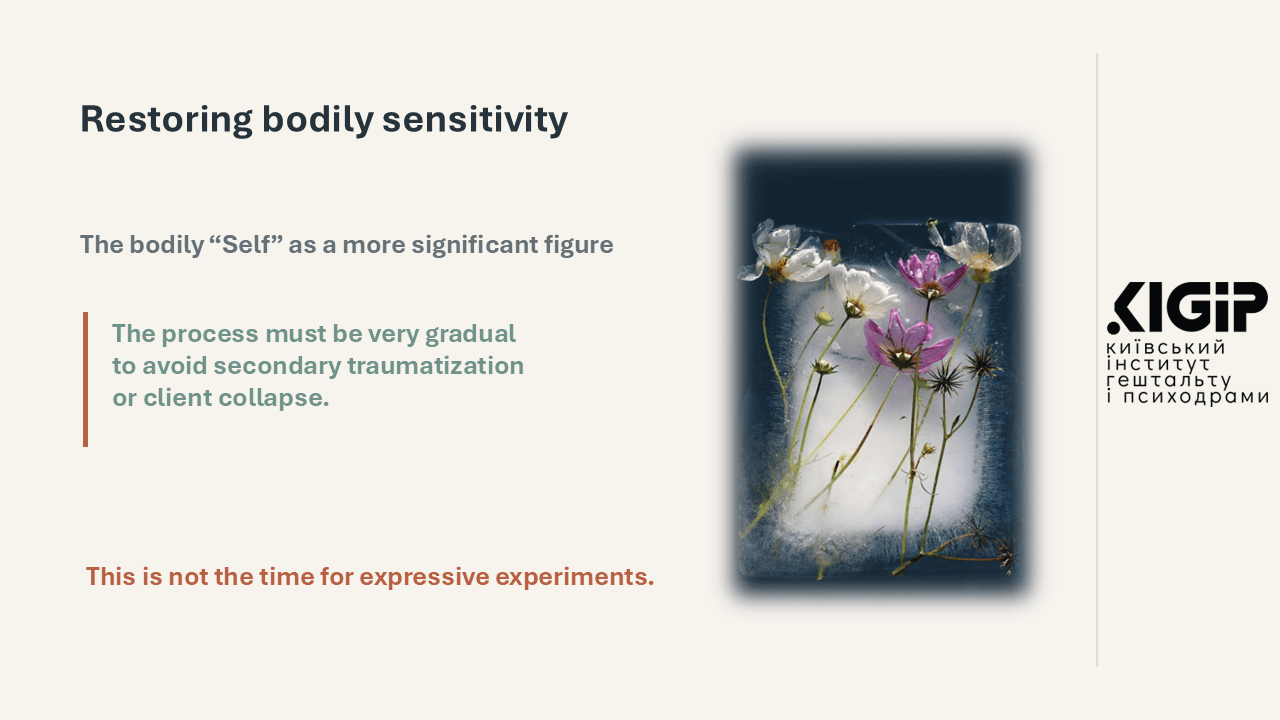
The third support is improving the ability to notice bodily sensations. In work with desensitization this process must be gradual, without intense expression. Activity can only strengthen the defense. If the therapist becomes yet another person who knows what the client needs to be like, they may come to be perceived as part of the dangerous environment. Our task is different: to support the system and help sensitivity appear gradually. Breath, movement and sometimes agreed-upon touch can help with this.
Touch is a very broad and ambiguous topic in psychotherapy, including in the Gestalt approach. With a proper contract it can sometimes be very healing, but there are many important limitations and nuances here.
First of all, we rely on the sensitivity that is already there. A client may say: “I don’t feel anything. I’m insensitive.” But how do they feel their insensitivity, in order to say they feel nothing? Somehow they have noticed it. And this may be the first touch of their own bodily experience. We stay with what is already there.
Breathing as a way of contact with the world
A pause in breathing may be connected with reduced sensitivity. In a session the therapist may notice that the client seems to stop, hold their breath, hold something back. Here it can be useful not so much to suggest a particular breathing technique as to explore, together with the client, their habitual breathing. What is it like now? Deep or shallow? Where in the body is it felt? What changes when the person notices the inhale and the exhale? We can explore breathing by looking for parallels with life. After all, breathing is one of the earliest and most direct ways of being in contact with the world. Inhaling, I contact the world and take something from it. Exhaling, I give something to the world.
Slow exploration of breathing patterns, with attention and support, can give access to small sensations. For example, one can invite the person to notice their state and, if it suits them, to try giving it a quiet sound on the exhale. There is no need to look for the right sound. One can simply listen to how what is here right now sounds, and what happens when the person hears themselves. It is a small movement that can nevertheless be very important. We do nothing excessive, we don’t demand big expression. We only allow the state to sound as much as is possible. This is a “message” that we send to the “green branch”—the ventral vagus. Sound is connected with breath, and through it we address the bodily state. In Gestalt therapy we are well familiar with the idea of giving voice to experience. It helps a person hear themselves—both literally and in a broader sense.
Starting with the part of the body that already feels
Another way I find in James Kepner, the author of the book Body Process. He suggested that clients with desensitization look for the part of the body that feels best at the moment and establish contact with it.
We don’t begin with the places where a person feels nothing, trying to force sensation back there. We look for the place where sensitivity is already available. And we gradually help to expand this bodily zone.
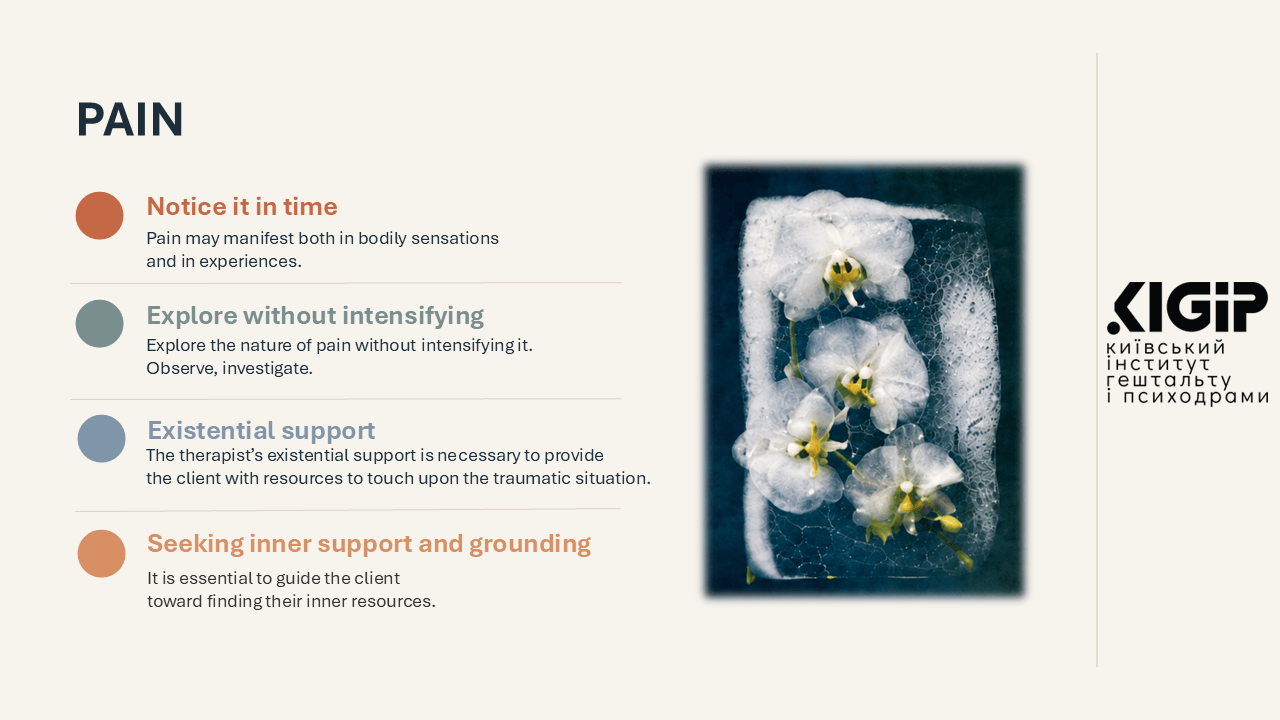
It is important to remember that in numb places, as sensitivity begins to return, pain may be the first thing to appear. Anyone who has had frostbite remembers: when a frozen part of the body begins to warm up, it may hurt at first. This is a very direct metaphor for our work. We have to notice the pain in time when it appears. It may show up in bodily sensations, emotions, experiences. We explore it, slow down, but do not intensify it. There is no need to melt what is frozen all at once and quickly. Recovery should happen gradually, exactly as far as is possible. And here the therapist’s existential support is needed.
Therapeutic traps: when we ourselves lose contact
Being with a client in a field where so much is frozen is not easy. That is why I pay special attention to the search for the therapist’s inner resource. We too are in this field. We too may get stuck, lose sensitivity, drift away from our own bodily experience.
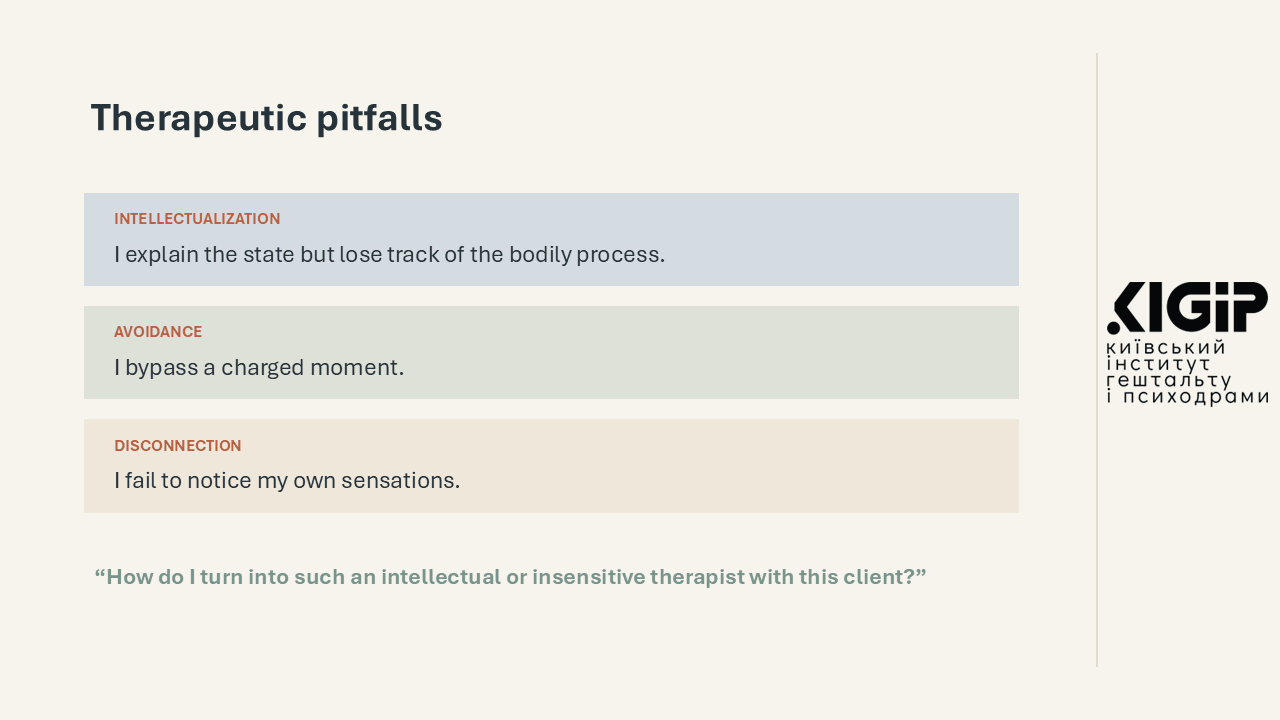
Sometimes a therapist falls into the trap of intellectualization. The conversation can be very interesting, lively, full of important thoughts. But at some point the therapist notices that they have stopped feeling themselves. This is another trap: loss of contact with one’s own bodily process. And yet another possible trap is avoiding emotionally charged moments.
The therapist’s return to their own sensitivity, the creation of a sensory background for the session, can become an invitation for the client to return to contact with themselves as well.
From working through a past threat to supporting life amid a present one
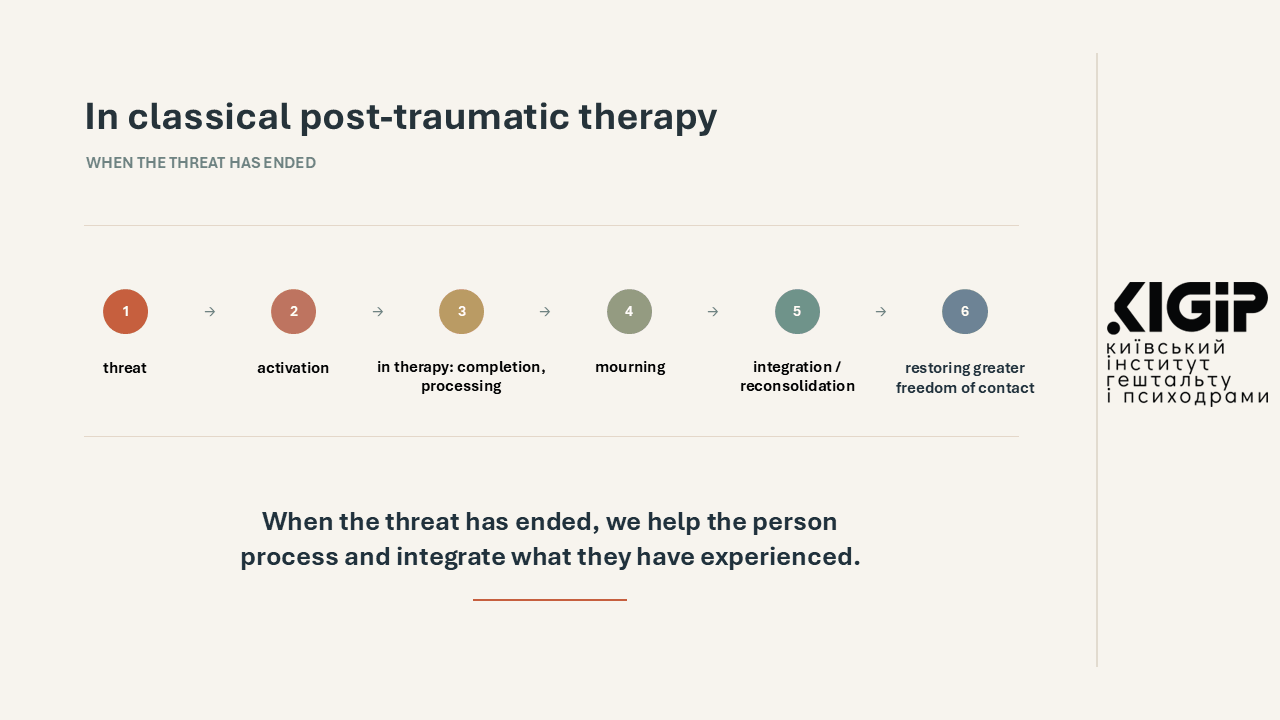
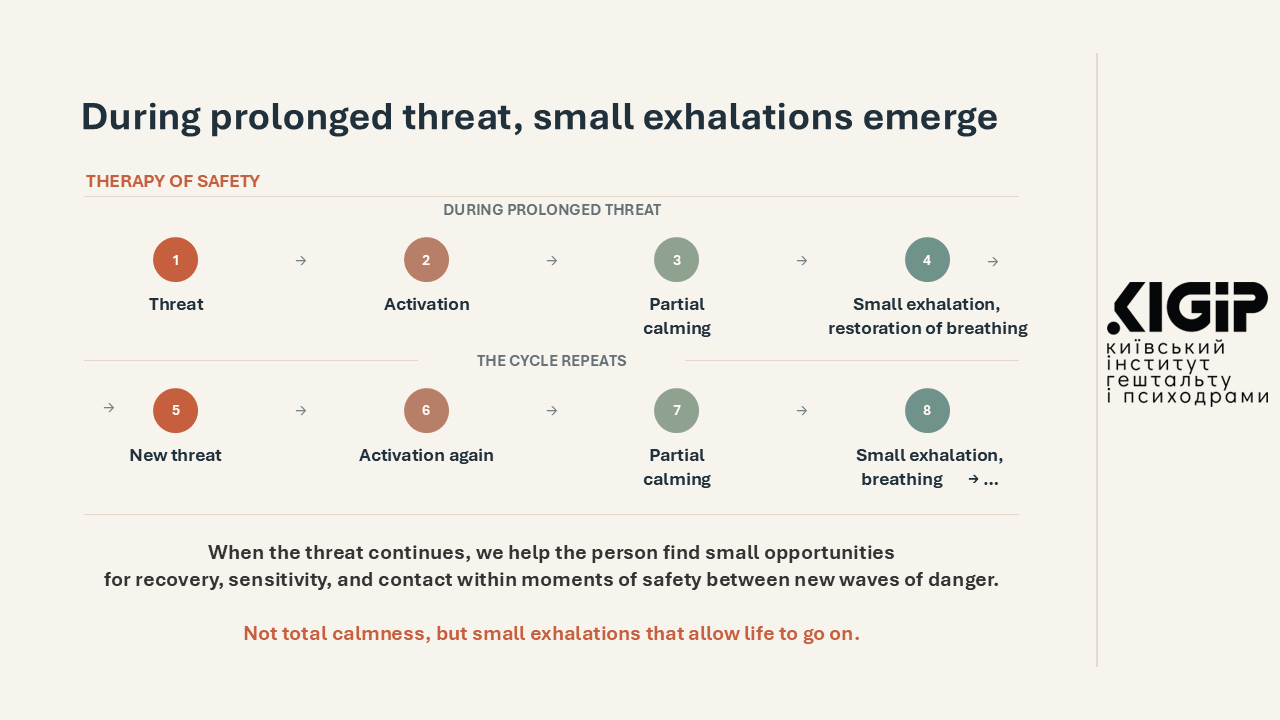
I want to return to the question I began with: what changes in our therapeutic work when the danger does not end? Once, at least in the context of the trauma work I studied in Ukraine, we often relied on this sequence: A threat occurred. Activation arose. The threat ended. After that we help the person complete what remained unfinished, work through the stopped energy, return to calm and integrate the experience. But during a prolonged threat the situation is different. Freezing becomes an adaptive mechanism, a human way of adjusting to the environment.
If we try to remove it without taking the real danger into account, we may only add load to the system. A nervous system that is already tuned to look for threat may perceive these attempts as one more danger. Now the sequence looks different. There was a threat. Activation arose. We help the person reach partial calming, partial thawing. But a threat arises again. Activation comes again. And again we support the possibility of at least partial calming. This repeats.
Here our work is not to bring the client fully back to the state they were in before the war, or to their previous level of activity and functioning. We work slowly, bodily, in small movements, with a sense of support, with a gradual completion of impulses. We help to restore flexibility in a field of prolonged threat. And this flexibility may consist even in being able to immobilize, to freeze, and then to restore contact again.
During prolonged threat, complete calming is not always possible. But partial calming is. A small movement. A slight return of sensitivity. The possibility of feeling oneself at least a little, touching support, finding a brief moment of calm. This helps the whole system stay alive and maintain adaptability.
The heart under the ice
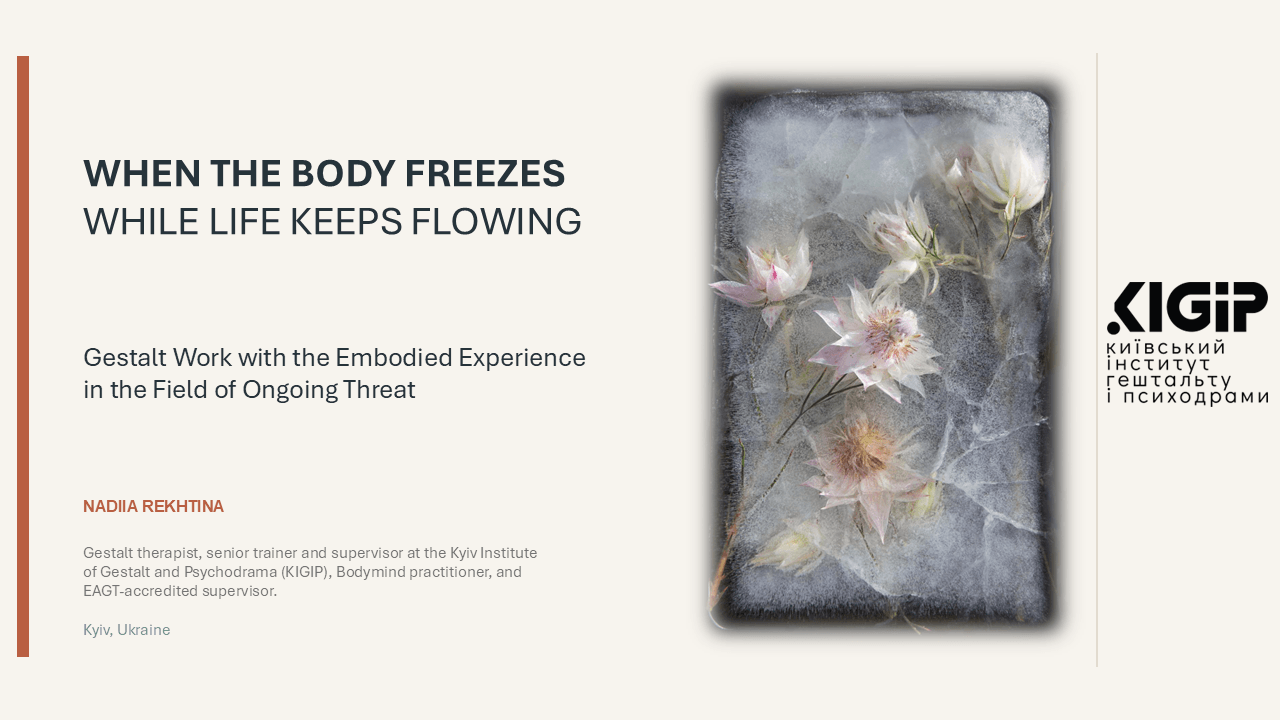
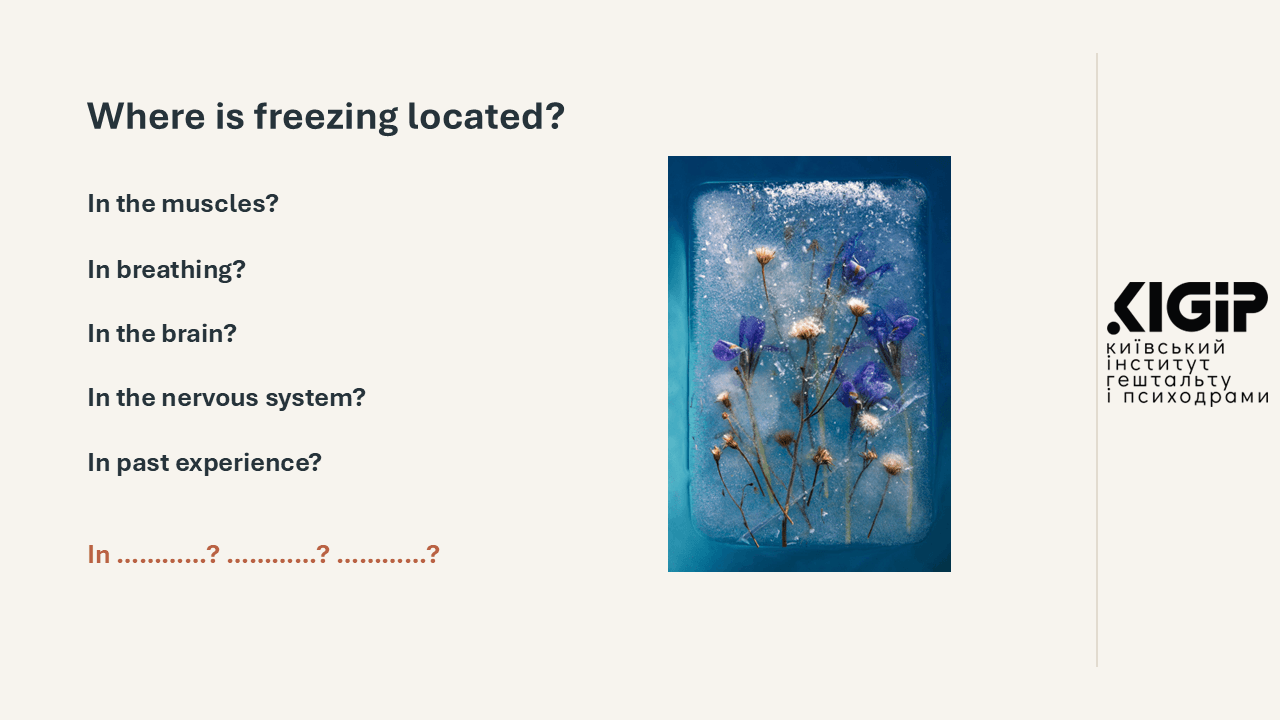
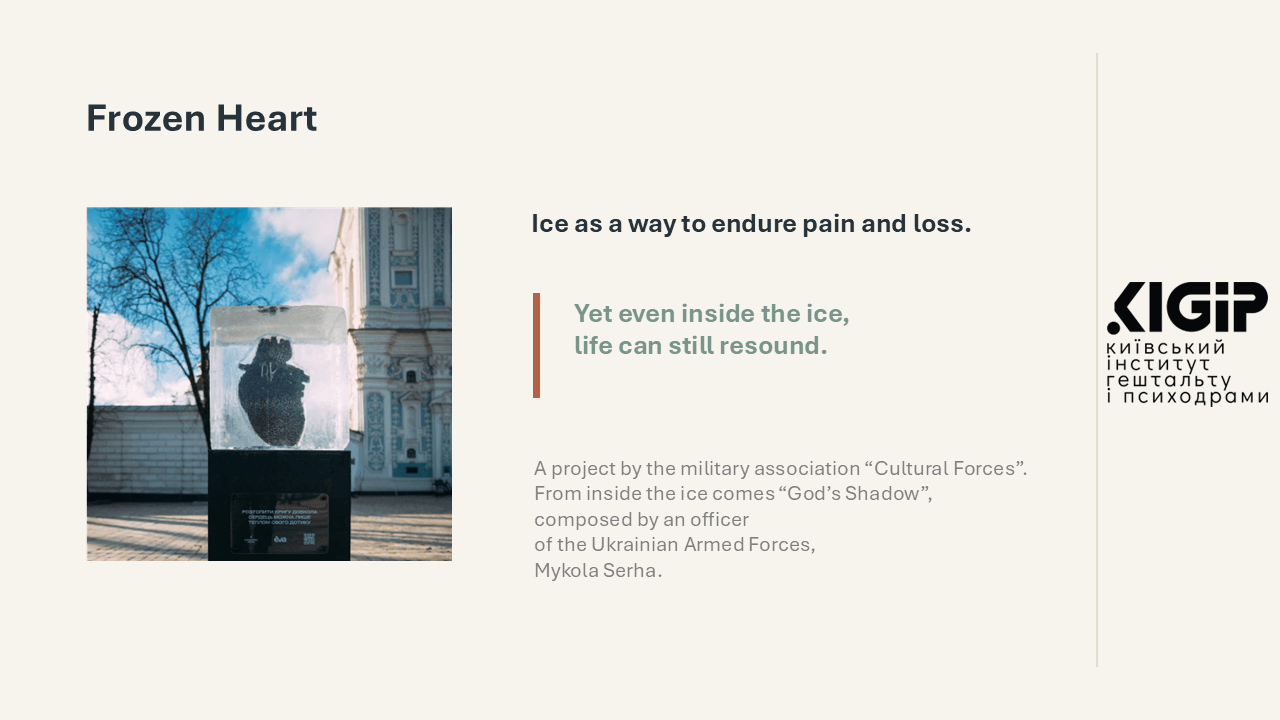
For me, the metaphor of the icy heart from the winter installation on Sophia Square in Kyiv became a source of support. It was created by the artist Mykola Serha. It was an iron heart with a speaker inside it. A song played in it, written and performed by a soldier. The heart was frozen in a large block of ice. Under the ice you couldn’t hear which song was playing. People walking past the installation could touch the ice with their palms. Touch by touch, the ice gradually melted.
Palm to palm. Drop by drop.
All this time we knew a song was playing there, but we couldn’t hear it. And gradually, thanks to these small touches, the song became audible.
References
- Nuttman-Shwartz, O., & Shoval-Zuckerman, Y. (2016). Continuous traumatic situations in the face of ongoing political violence: The relationship between CTS and PTSD. Trauma, Violence, & Abuse, 17(5), 562–570.
- Sagy, S., & Braun-Lewensohn, O. (2009). Adolescents under rocket fire: When are coping resources significant in reducing emotional distress? Global Health Promotion, 16(4), 5–15.
- Porges, S. W. (2007). The polyvagal perspective. Biological Psychology, 74(2), 116–143.
- Porges, S. W. (2009). The polyvagal theory: New insights into adaptive reactions of the autonomic nervous system. Cleveland Clinic Journal of Medicine, 76(Suppl. 2), S86–S90.
- Porges, S. W. (2022). Polyvagal theory: A science of safety. Frontiers in Integrative Neuroscience, 16, 871227
- Porges, S. W. (2023). The vagal paradox: A polyvagal solution. Comprehensive Psychoneuroendocrinology, 16, 100200.
- Dana, D. (2018). The polyvagal theory in therapy: Engaging the rhythm of regulation. W. W. Norton & Company.
- Kozlowska, K., Walker, P., McLean, L., & Carrive, P. (2015). Fear and the defense cascade: Clinical implications and management. Harvard Review of Psychiatry, 23(4), 263–287.
- Pechtel, P., & Pizzagalli, D. A. (2011). Effects of early life stress on cognitive and affective function: An integrated review of human literature. Psychopharmacology, 214(1), 55–70.
- Roelofs, K. (2017). Freeze for action: Neurobiological mechanisms in animal and human freezing. Philosophical Transactions of the Royal Society B: Biological Sciences, 372(1718), 20160206.
- Beisser, A. R. (1970). The paradoxical theory of change. In J. Fagan & I. L. Shepherd (Eds.), Gestalt therapy now (pp. 77–80). Science and Behavior Books.
- Kepner, J. I. (1987). Body process: A Gestalt approach to working with the body in psychotherapy. Gardner Press.
- Parlett, M. (1991). Reflections on field theory. The British Gestalt Journal, 1(2), 68–91.
- Perls, F. S., Hefferline, R. F., & Goodman, P. (1951). Gestalt therapy: Excitement and growth in the human personality. Julian Press.